Encrypted Messaging
Dual-Layer Encryption over LoRa
Two independent encryption layers. Group PSK: PBKDF2-HMAC-SHA256 derived AES-256-GCM
key (10,000 iterations) encrypts all traffic. E2E direct messages: ephemeral ECDH P-256
key exchange auto-negotiated via beacons, with per-boot forward secrecy.
All crypto runs on-device via mbedTLS. PSK encrypted at rest with device-specific wrapping.
ECDH P-256
PBKDF2
AES-256-GCM
Forward Secrecy
Voice over LoRa
Codec2 — Three Voice Modes
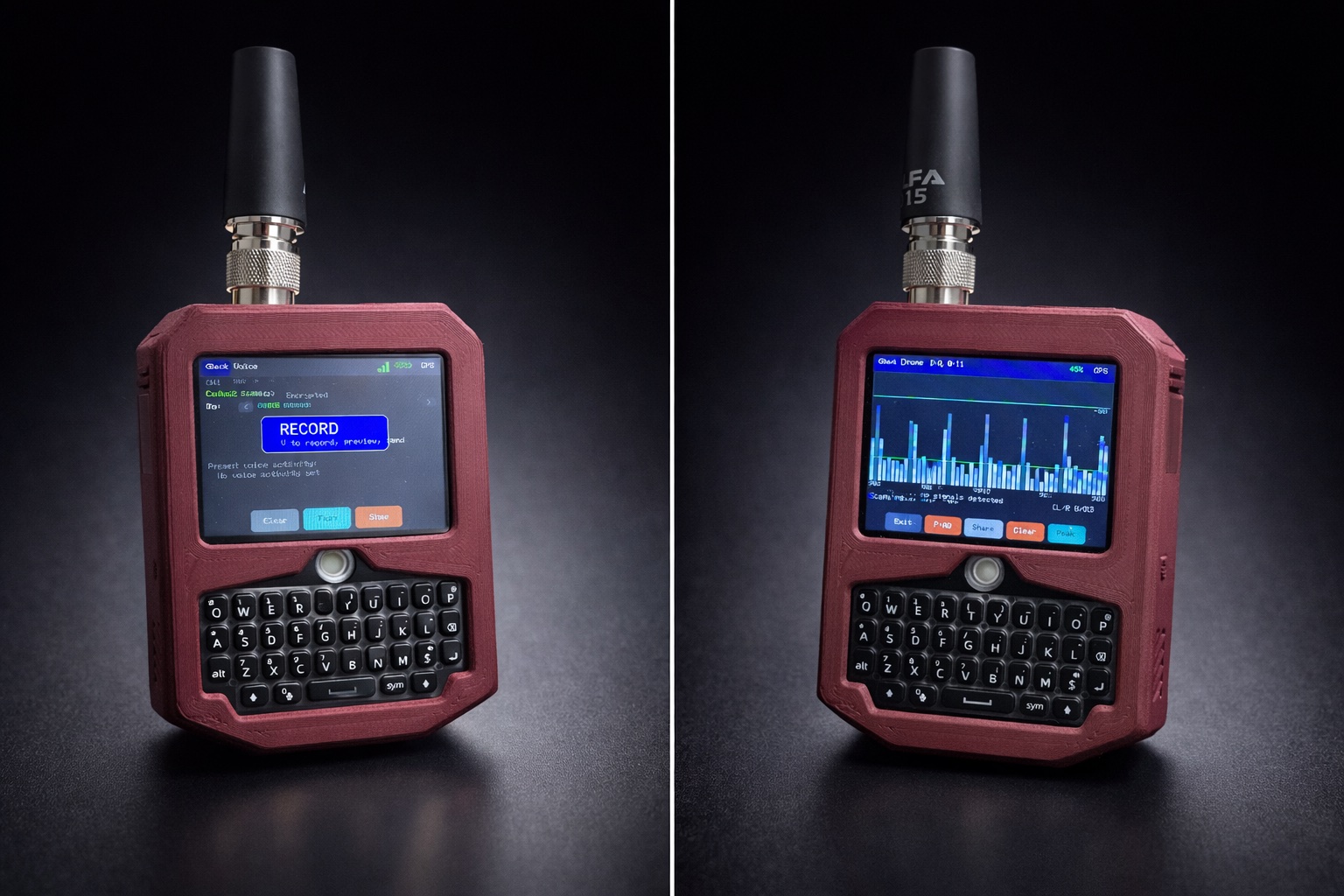
Voice messages captured from the onboard ES7210 quad-channel I2S microphone,
compressed with Codec2 (1600 or 3200 bps), encrypted, fragmented into LoRa-sized
packets, and reassembled on the receiving end. Three modes: Range (1600 bps, 2× redundancy),
Balanced (3200 bps, 2× redundancy), Clarity (3200 bps, single pass).
Record, preview, send — with full DSP pipeline including AGC, noise gate, biquad IIR
filtering, and pre/de-emphasis. Cross-mode interoperability — receivers auto-detect.
Codec2 1600/3200
ES7210 ADC
Preview Before Send
3 Quality Modes
Image Messaging
Encrypted JPEG transfer over LoRa
Send photos across the mesh when there's no network at all. Images are compressed to
JPEG (up to 240×180, a few KB), split into 180-byte chunks, encrypted with the group PSK
(AES-256-GCM), and reassembled on the receiver. Integrity is checked twice — a CRC-16 on
every chunk and a SHA-256 over the whole image — and the receiver NACKs any missing chunks
for automatic retransmission. Transfers run at BULK priority, so live voice, direct messages,
and beacons always take the channel first. Received images are written to the SD card for
on-device viewing and pushed to the GridDown PWA. Direct-only — image chunks never
mesh-relay, keeping bulk data off multi-hop paths.
JPEG ≤240×180
AES-256-GCM (PSK)
CRC-16 + SHA-256
Auto-Retransmit
Channel Hopping
Frequency-agile transmission
8 channels across the 902–928 MHz ISM band (2.5 MHz spacing) with pseudorandom hop sequences
derived from the shared group PSK. GPS-synchronized 30-second hop slots — all radios with the
same PSK and GPS lock hop in unison. Without the group key, an observer sees random
encrypted packets on random frequencies. Requires GPS position lock to activate —
radios without GPS stay on their configured base channel.
8 Channels
GPS-Synced 30s Slots
PSK-Derived Sequence
Auto-Fallback
900 MHz Drone Scanner
Passive RF detection on the ISM band
The SX1262 LoRa transceiver does double duty as a passive 900 MHz RF scanner.
Sweeps 52 channels across 902–928 MHz in 500 kHz steps using dual-mode detection —
LoRa CAD for preamble detection and RSSI energy detection for non-LoRa signals.
Classifies ELRS, Crossfire, SiK/RFD900, and separates drones from LoRaWAN infrastructure.
52 Channels
CAD + RSSI
4 Scan Profiles
RF Baseline
Remote ID Drone Detection
ASTM F3411 identity, and the drones that aren’t broadcasting it
Receives ASTM F3411 / Open Drone ID broadcasts on 2.4 GHz over four transports —
WiFi beacon, WiFi NAN, and BLE legacy and long-range — tracking up to 16 aircraft at once
with UAS ID, operator ID, position, altitude, speed, heading, and the operator’s own
takeoff location. Detections cross-reference the 900 MHz scanner: a compliant drone confirmed on
both is corroborated, while a 900 MHz control link with no Remote ID broadcast is
escalated as the highest-interest case. Duty-cycled so Remote ID scanning never starves the LoRa radio.
ASTM F3411
WiFi + BLE
16 Tracks
Operator Location
900 MHz Correlation
Gunshot Detection
Acoustic impulsive transient detector
Background acoustic monitoring via the ES7210 microphone. Pure DSP — no ML models.
Detects impulsive transients with rise time < 1ms, peak amplitude 6–20× above an
adaptive noise floor, and multi-sample confirmation (3–5 hits within 150–200ms).
Wind and engines raise the noise floor gradually and don't trigger. GPS-tagged
detections broadcast over LoRa automatically.
3 Sensitivity Levels
Adaptive Noise Floor
GPS Tagged
Auto LoRa Alert
Jamming Detection
Coordinated channel migration
Continuous noise floor monitoring on the active messaging channel. If sustained
energy 20+ dB above baseline is detected for 10 seconds, the system confirms jamming and
initiates coordinated channel migration — all radios in the group switch to the quietest
available frequency simultaneously. Adaptive baseline rejects gradual environmental changes.
Voice activity automatically suppresses detection to prevent false triggers during TX/RX.
20 dB Threshold
Auto-Migrate
Coordinated Switch
Adaptive Baseline
Mesh Relay
Multi-hop range extension
Messages automatically relay through intermediate radios to extend range across a team.
Up to 4 hops for text messages, 2 hops for voice. Hash-based deduplication prevents
relay storms. Store-and-forward queues messages for offline peers and delivers
automatically when they come back into range.
4-Hop Text
2-Hop Voice
Store & Forward
Deduplication
Duress & Remote Wipe
Covert distress + authenticated erasure
Covert duress signaling — a silent distress flag embedded in normal messages that alerts
teammates without the captor's knowledge, with GPS coordinates when available. Authenticated
remote wipe erases a device via HMAC-signed, PSK-encrypted command with GPS-synced
replay protection.
Silent Duress
Remote Wipe
HMAC Signed
Replay Protected
Standalone Operation
Full UI on the radio hardware
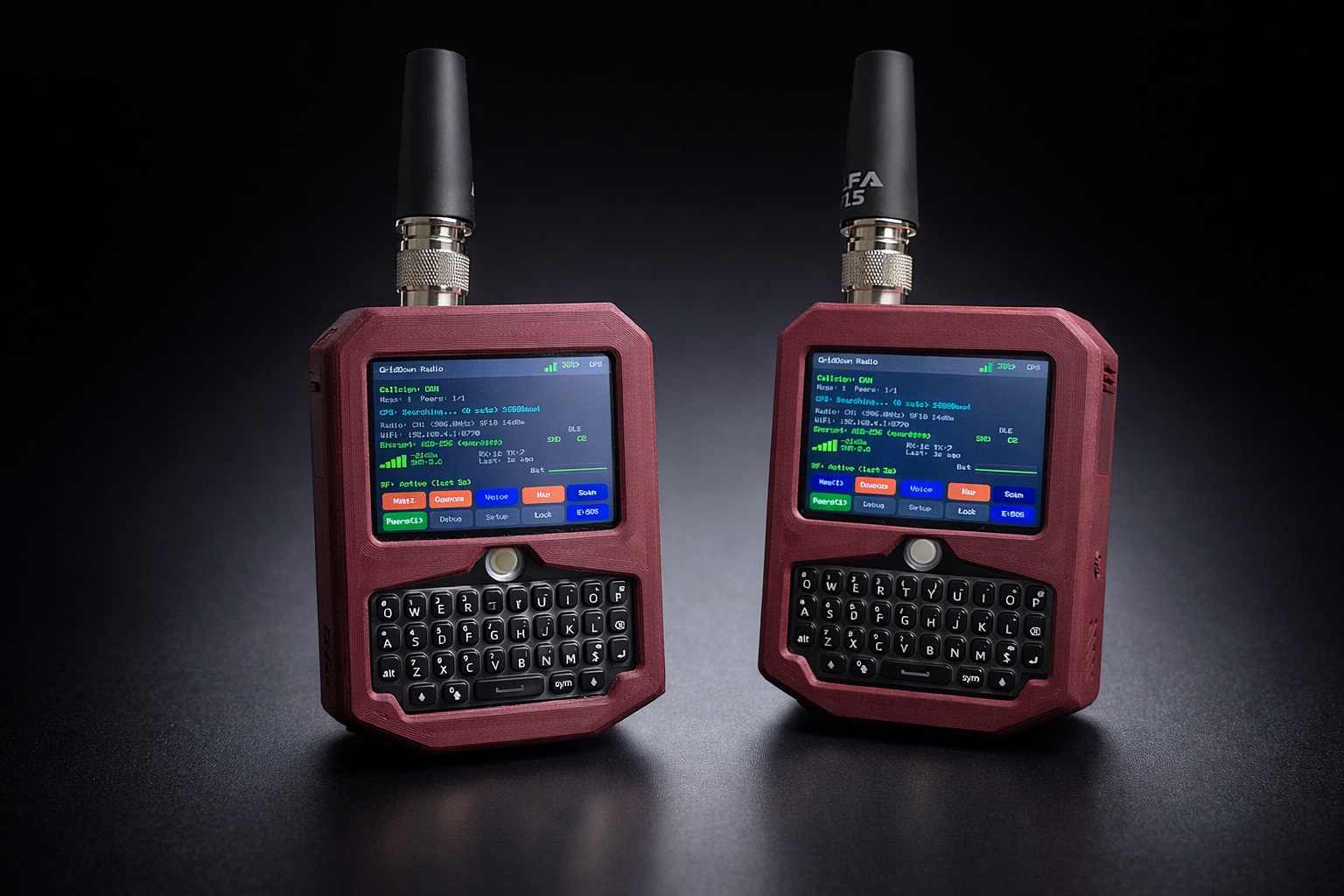
The radio operates independently with a built-in display, keyboard, and trackball.
Peer-threaded conversations, group broadcast ACK (per-peer delivery tracking),
canned messages, 4 group channels, channel scan on boot, WiFi QR code display,
calibrated battery monitoring, WCAG-compliant button contrast, and a hold-to-activate
emergency broadcast from any screen including lock. Three WiFi modes (AP/STA/OFF) with
mDNS discovery and zero-touch credential push from the tablet.
TFT Display
WiFi AP/STA/OFF
BLE + WiFi Bridge
GPS Onboard
TAK / CoT Bridge
Cursor-on-Target integration
Bidirectional Cursor-on-Target bridge with four output modes: OFF, Multicast
(UDP 239.2.3.1:6969), TCP (configurable TAK server), and All. Triple output
paths: WebSocket to GridDown PWA, UDP multicast to ATAK, TCP to TAK server.
Inbound CoT events converted to peers, tracks, and waypoints. Duress alerts
forwarded as TAK events with GPS coordinates.
ATAK Multicast
TCP TAK Server
Bidirectional
Duress → CoT
Tactical Waypoints
Shared markers across the mesh
Named waypoints shared via 4-hop mesh relay and persisted to device storage.
Quick-drop from map screen, compose command (/wp Name), or tablet push.
6 icon types for different marker purposes. Waypoints appear on all peer
devices and on the GridDown PWA map.
4-Hop Shared
6 Icon Types
Quick Drop
Persistent
Threat Proximity Alerts
Configurable perimeter warnings
Automatic warnings when situational awareness tracks enter a configurable radius
(500m to 10km). Displays bearing, distance, and altitude trend. 30-second
cooldown prevents alert fatigue. Integrates with drone scanner detections
and peer tracking data.
500m – 10km
Bearing + Distance
Cooldown
Auto Alert
Channel Scan on Boot
Find your team instantly
Automatic 8-channel CAD + RSSI sweep on every startup (~5 seconds).
10 CAD probes at SF10/BW125 plus 5-sample median RSSI per channel. Active
channels highlighted in green with hit counts. Operators joining late or
recovering from a reboot can immediately see which channel their team is on.
Auto on Boot
8 Channels
CAD + RSSI
~5 Seconds
Group Broadcast ACK
Per-peer delivery confirmation
Broadcast messages track per-peer delivery with lightweight ACK packets
and jittered transmission to avoid collisions. 16-bit bitmask dedup prevents
double-counting. Display shows confirmed/total (e.g., 3/5) with color coding:
grey = none, yellow = partial, green = all confirmed. Supports up to 16 peers.
Per-Peer Tracking
Collision Jitter
16 Peers Max
Color Status
WiFi Connectivity
Three operating modes + mDNS discovery
AP mode creates a standalone network (scan QR to join). STA mode joins your
tablet hotspot for a unified network with the GridDown Sensor Hub. OFF mode disables
WiFi entirely for maximum battery life. mDNS registers as griddown-radio.local
in STA mode. Zero-touch credential push from the tablet via WebSocket — operator
confirms on-device before switching. QR code display adapts to the active mode.
AP / STA / OFF
mDNS Discovery
WiFi QR Code
Credential Push