The GridDown Sensor Hub is a passive, receive-only appliance that fuses airspace, maritime, drone, emergency-beacon, and environmental & safety data into a single live feed — delivered to GridDown Maps and to any TAK client as Cursor-on-Target. Plug it in, and everything shows up on one map. No cloud, no subscription.
The Sensor Hub only listens. It receives on every band it monitors and never transmits, so it adds no signature of its own. All processing happens on the device and on your own network — there is no cloud backend and no account. Data flows to your GridDown tablet and your TAK clients over the network you control.
One unit replaces a rack of single-purpose receivers: aircraft, vessels, drones, emergency beacons, air quality, gas, weather, water, solar, and level — normalized into one stream and one map, with a standards-based threshold-alarm engine on top (and, on Pro, a downwind plume estimate).
It works on the network you have: the hub can join your existing Wi-Fi, run its own access point when nothing else is reachable, or sit on a wired link for a fixed install — all three at once if you want. Software updates are signed and applied from an uploaded bundle with automatic rollback, so a hub deep off-grid never needs an internet connection to stay current.
The Hub Is the Fusion Layer. The Instruments Are Yours.
The Sensor Hub's job is not to sell you sensors — it is to turn whatever you already run into one coherent picture. Its onboard sensors are a starting point, not a fence. Third-party instruments join the same data plane over Modbus (RTU or TCP) or a local HTTP API, and adding one is a configuration entry, not a firmware build.
That matters because of what sits downstream. The threshold-alarm engine, the plume estimate on Pro, the unified GridDown feed, and the Cursor-on-Target output all consume one normalized plane — so an instrument you bought and bolted on gets exactly the same treatment as one that shipped in the box: the same alarms, the same map, the same TAK feed. Nothing is second-class for having come from somewhere else.
The plane is open by design. New classes of instrument join it the same way the existing ones did, which is how the hub grows without you replacing it.
Variants
Consumer & Pro
Both variants share the same passive sensor platform, the same alarm engine, and the same GridDown and TAK output. Pro adds professional-grade detection and defense-oriented, TAA-conscious sourcing.
Preparedness / SAR / Field
Sensor Hub — Consumer
Full passive situational awareness in one plug-and-play appliance. Airspace, maritime, drone, and emergency-beacon detection plus onboard environmental and safety monitoring, with threshold alarms and a downwind plume estimate — all on your GridDown map.
ADS-B (1090) & UAT (978) aircraft + FIS-B weather
AIS vessel tracking
406 MHz COSPAS-SARSAT emergency beacons
Drone Remote ID detection (ASTM F3411)
Onboard air quality, gas (CO/O₂), combustible-gas, lightning & UV
GNSS self-location
External-instrument ingest (Modbus & local HTTP)
Standards-based threshold alarms with preset profiles
Unified feed to GridDown + Cursor-on-Target to TAK
Everything in Consumer, upgraded for safety- and defense-grade operations: professional drone detection, survey-grade positioning with heading and attitude, %LEL combustible-gas, and professional multi-gas detection with gamma dose-rate. Configured for TAA-conscious, defense-oriented sourcing.
Introductory pricing, subject to change. Volume pricing and government purchase orders accepted — contact sales. Pro multi-gas and specialty instruments are configured per mission. Export control: ECCN 7A994 — Anti-Terrorism control only. Not ITAR. US customers, US deployment only.
Capabilities
What the Hub Sees
Every subsystem is passive and receive-only, normalized into one feed for GridDown and TAK.
Airspace Awareness
ADS-B (1090 MHz) and UAT (978 MHz) aircraft tracking, plus FIS-B weather received off-grid on the 978 band.
Maritime Tracking
AIS vessel positions, headings, and identities plotted alongside everything else on the map.
Drone Detection
Remote ID drone telemetry (ASTM F3411 / DIN EN 4709) — operator and aircraft positions where broadcast.
Emergency Beacons
406 MHz COSPAS-SARSAT reception decodes ELT, PLB, and EPIRB distress beacons and plots their positions.
Air & Safety Monitoring
Onboard particulate / CO₂ / VOC air quality, CO and O₂ gas, combustible-gas, lightning distance, and UV — at the hub's location.
External Instrument Ingest
Reads third-party gas, water-quality, weather, solar, and level instruments over Modbus (RTU/TCP) and local HTTP — no firmware changes.
Threshold Alarms
Per-channel thresholds trip an on-device indicator, a banner on the GridDown tablet, and a CoT alert to TAK. Action levels come from a preset profile library built on published standards — confined-space entry is the default — rather than hand-typed numbers.
Plume Fusion PRO
On the Pro variant, combines gas readings with wind to draw an indicative downwind hazard wedge on the map and in CoT.
AC Magnetic-Field Detection PRO
A high-resolution magnetometer watches for alternating magnetic fields — the signature of energised conductors and running machinery. A frequency-domain detector runs over roughly one-second windows and publishes a detection about once a second. The raw high-rate magnetic data never leaves the device: detection happens in process, and only the result reaches the bus and your map.
Indoor Positioning, GPS-Denied PRO
Inside a structure where satellites are unavailable, the hub estimates position from the building’s own magnetic signature. Walk the space once in survey mode to build a map anchored at the entry point; afterwards, localise mode matches the live field against that map to correct dead-reckoning drift, publishing a corrected position with its uncertainty and a trust score. The solving happens on the hub, not the tablet — the tablet displays the fix and can feed it into its own navigation. Requires the Pro variant’s inertial and magnetic sensing.
GridDown + TAK Output
A unified feed to the GridDown tablet, plus Cursor-on-Target to ATAK, WinTAK, iTAK, WebTAK, and FreeTAKServer.
Interface
The Admin Console
Everything the hub does is configured from a browser on your own network — no cloud account, no app to install, no BlackAtlas login. These are real screens from a running unit.
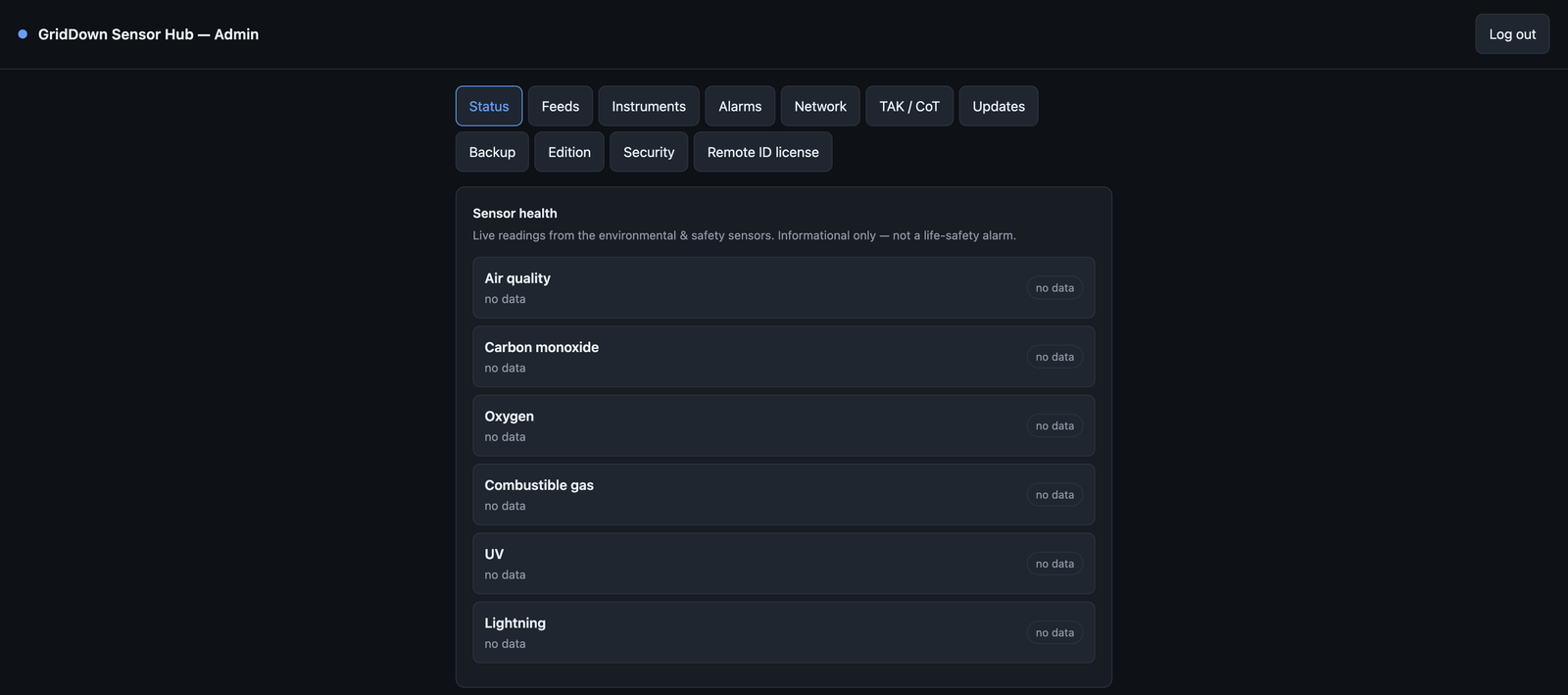
Status — sensor health at a glance.
Every environmental and safety channel the unit is reporting, in one list, with live values and a plain state for each. The console tells you what it is and is not: these are informational readings, not a certified life-safety alarm. Tabs across the top cover feeds, external instruments, alarms, networking, TAK output, updates, backup, and licensing — the whole unit, from one page.
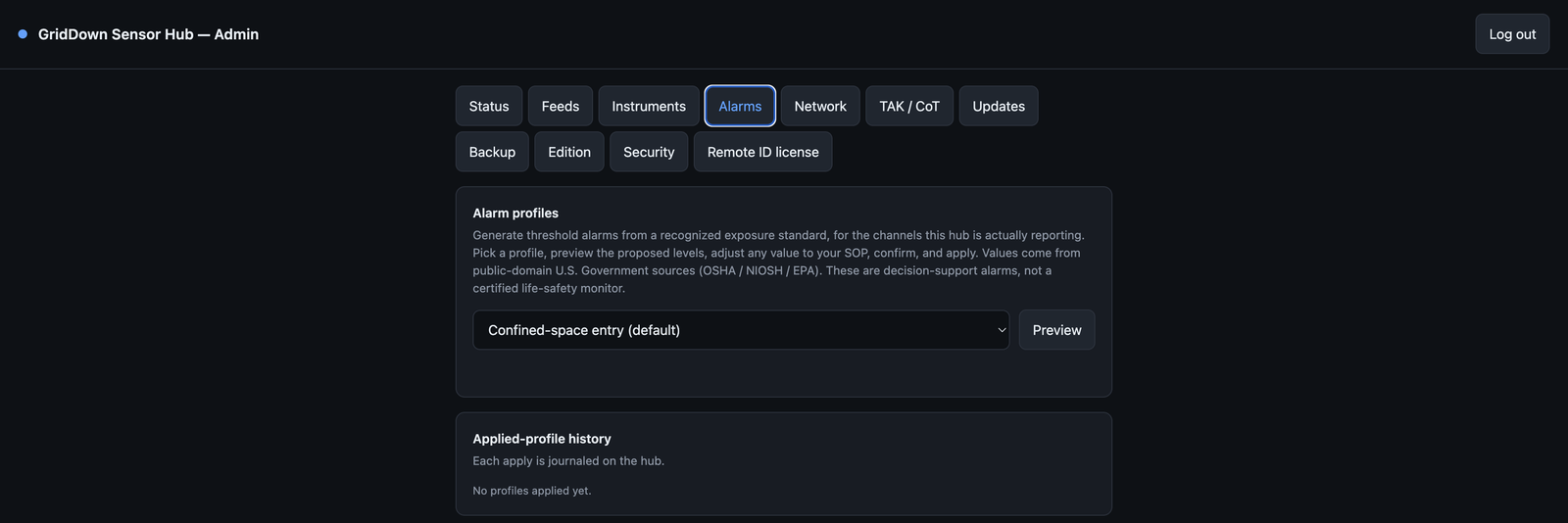
Alarms — thresholds from a standard, not from guesswork.
Pick a recognised exposure profile and the hub proposes action levels for the channels it is actually reporting, drawn from public-domain US Government sources. Preview the proposed values, adjust any of them to your own SOP, then confirm and apply. Every apply is journalled on the unit, so you can show which profile was in force and when it changed.
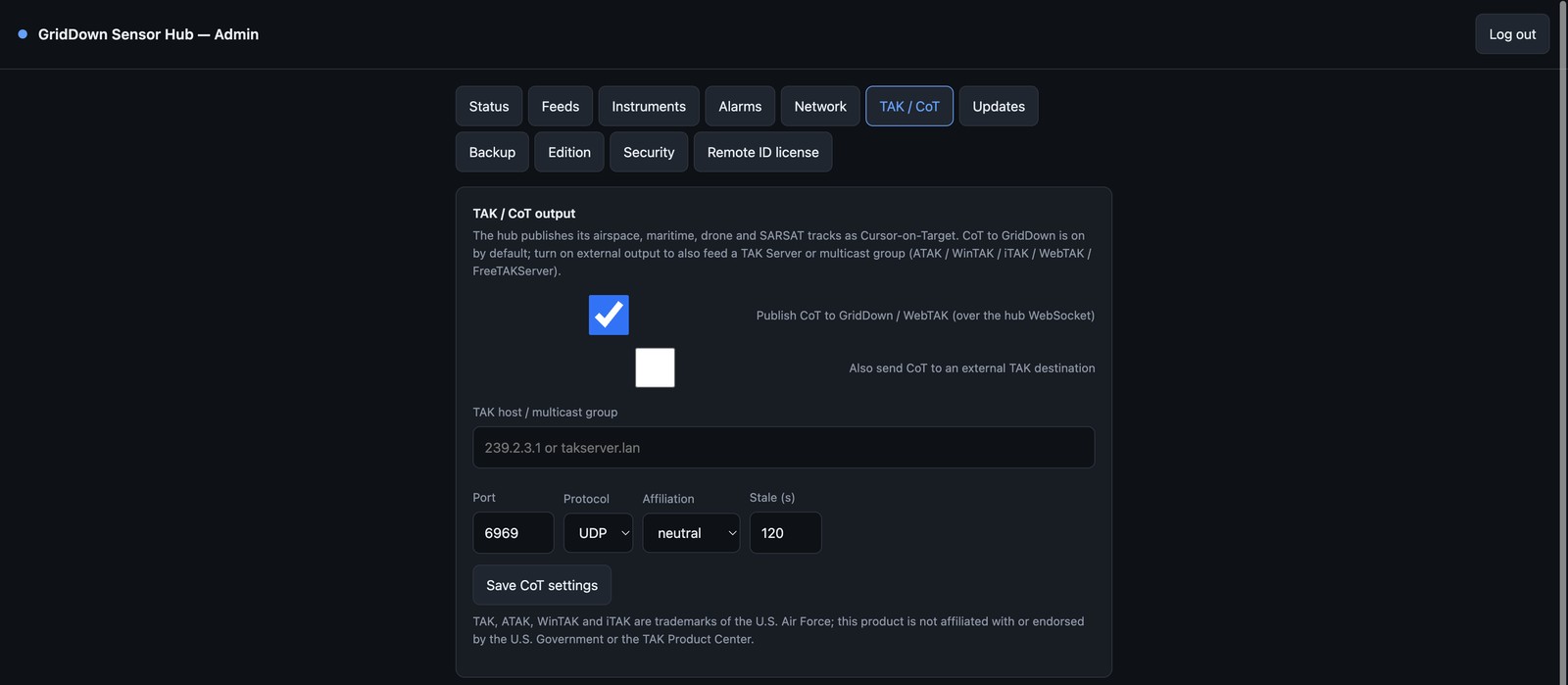
TAK / CoT — into the picture you already run.
Airspace, maritime, drone, and emergency-beacon tracks publish as Cursor-on-Target. Output to GridDown is on by default; point it at a TAK Server or a multicast group and the same tracks reach ATAK, WinTAK, iTAK, WebTAK, or FreeTAKServer. Host, port, protocol, affiliation, and stale time are all yours to set.
Screens are from a unit on a bench with no sensors attached, so the channels read no data. Network addresses have been removed.
External COTS Integrations
Works With Instruments You Already Trust
You buy the instruments; the hub fuses them. These are the integrations we have vetted and shipped templates for — each one is a configuration entry away from appearing on your map, in your alarms, and in your TAK feed:
AirGradient ONE / Open Air
Air quality — PM, CO₂, VOC, NOx — over the local network, or wired over USB-C to drop the Wi-Fi dependency entirely.
Industrial Scientific Ventis Pro5 · Radius BZ1 PRO
Professional multi-gas detection (LEL, CO, H₂S, O₂ and more), with gamma dose-rate on the Radius BZ1.
In-Situ Aqua TROLL 500 / 600
Water quality — pH, dissolved oxygen, conductivity, turbidity, ORP, temperature.
Sky-view UV irradiance; a commercial-tier UV option is available on the Consumer variant.
Level & Flood Stage
Ultrasonic or radar standoff sensors for flood-stage, tank, or snow depth.
The vetted list is a floor, not a ceiling. The hub can read virtually any Modbus RTU/TCP or local-HTTP instrument once a matching template is configured — no firmware build, no return to us — and every reading flows straight to GridDown and TAK on the same data plane. If you run something we have not listed, ask.
The Sensor Hub is a sensor source for everything else you run.
GridDown Maps
Every track, beacon, and reading plots on your offline common operating picture.
TAK / CoT
Cursor-on-Target output to ATAK, WinTAK, iTAK, WebTAK, and FreeTAKServer.
Geofence Zones
Sensor and alarm events cross-reference GridDown zones for automatic, named alerts.
AtlasRF
Pairs with broader passive RF monitoring for a deeper spectrum picture.
AtlasBridge
Translate sensor data into wider C2 environments.
Threshold Alarms
Per-channel alarms surface on the tablet and as CoT, built from standards-based preset profiles. The downwind plume wedge is a Pro capability.
Request a Quote
Tell us your mission and which variant fits. We'll spec the right configuration — including any professional or specialty instruments — and follow up with pricing and lead time.