Navigation
Multi-source positioning
Standard GPS with automatic fallback to inertial navigation and pedestrian dead reckoning.
Barometric altimeter, magnetic compass, and route planning with terrain analysis.
Works indoors, underground, and in GPS-denied environments.
GPS + INS
Dead Reckoning
Route Planning
Elevation Profile
Celestial Navigation
Ancient methods, modern precision
Determine your position using sun, moon, and stars when GPS is unavailable or compromised.
Camera-based sextant for altitude measurements, automatic sight reduction, and position fixing.
No satellites required—just clear sky.
Sun/Moon/Stars
Camera Sextant
LOP Calculation
Almanac Data
Team Coordination
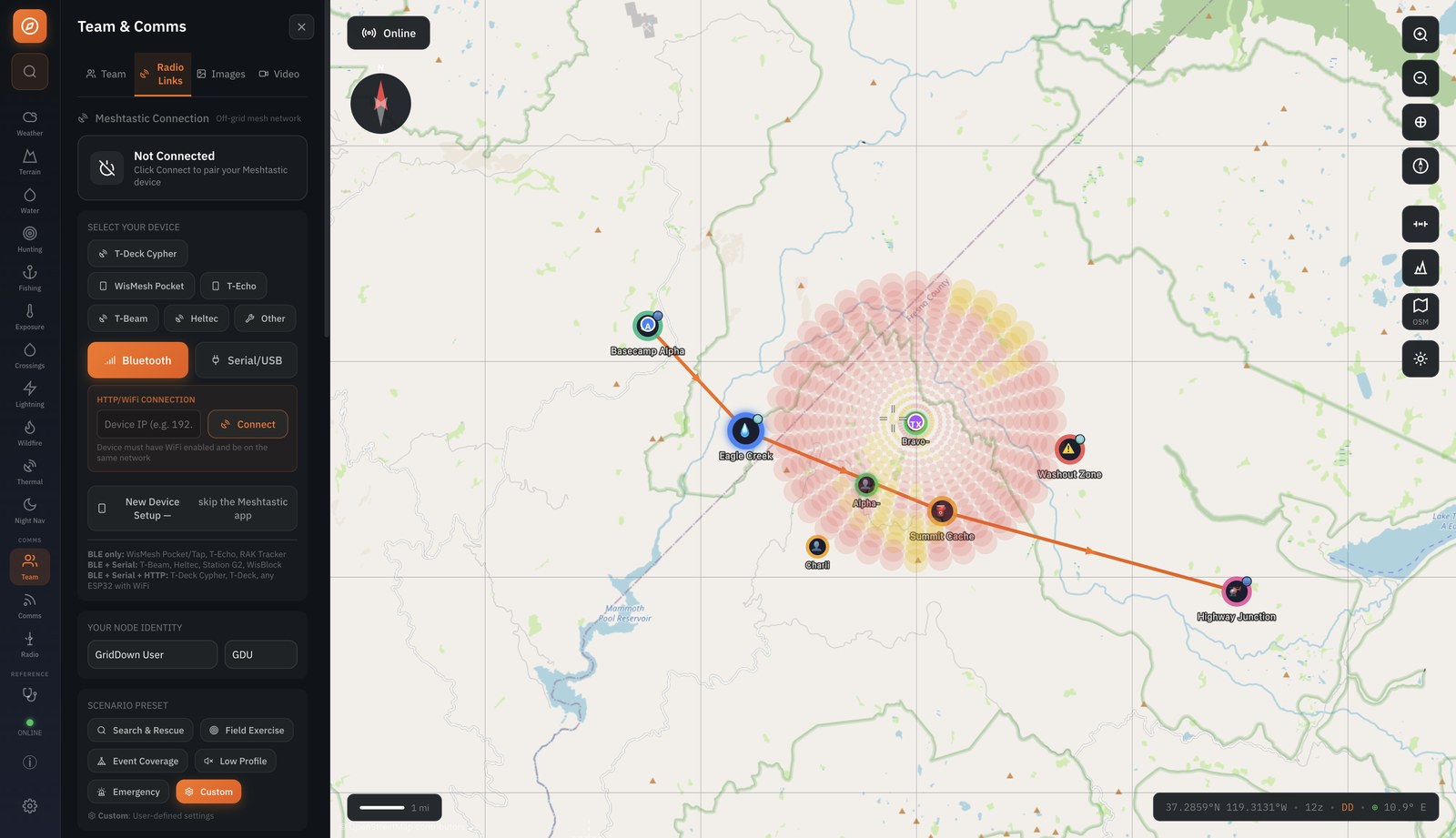
Mesh-networked SA
Share positions and status with your team over Meshtastic mesh radio—no cellular required.
View team members on the map, send waypoints, and coordinate movements. Full Cursor on Target
interoperability via CoT Bridge for mixed-capability teams.
Meshtastic
APRS
CoT Bridge
PLI Sharing
RF Situational Awareness
Aircraft, ships & drones via SDR
Pair with an AtlasRF SDR feed or the GridDown Sensor Hub to plot ADS-B aircraft, AIS vessels, Remote ID and
FPV drones, weather radiosondes, and APRS stations on the live map. Decode FIS-B (978 MHz) weather
off-grid, and surface emergency squawks (7500/7600/7700) and maritime SART/EPIRB alerts automatically.
ADS-B / AIS
Drone Remote ID
FIS-B Weather
Squawk Alerts
Weather Intelligence
Multi-source forecasting
Cache NWS and IEM weather data before going offline, or receive real-time weather via
AtlasRF's FIS-B decoder (978 MHz). View radar, forecasts, and alerts without internet, layer NASA
satellite imagery and EPA AirNow air-quality data, and pull sun/moon times and magnetic declination for
any point. Barometric pressure tracking for local weather prediction.
NWS/IEM Cache
FIS-B Weather
Radar Imagery
Pressure Trend
Emergency Tools
Critical situation support
SOS beacon generator, signal-mirror sun-angle calculator, distress-signal reference, and contingency
planning. Pre-plan evacuation routes and cache emergency contact cards. With the Sensor Hub's integrated
406 MHz SARSAT receiver, detect emergency beacons (ELT/PLB/EPIRB) and plot decoded positions on the map
with approach/recede trend analysis.
SOS Generator
Signal Mirror
Evac Planning
Beacon Detect
Communications
Radio frequency planning
Generate comprehensive communication plans with frequency allocations, call signs, and
schedules. RF line-of-sight analysis using terrain data. Repeater database and coverage
mapping. SSTV image encoding/decoding for radio image transmission.
Comm Plans
RF LOS Analysis
SSTV TX/RX
Repeater DB
Bring Your Own Radio
Any Meshtastic-compatible node, three ways to connect
There is no approved-hardware list to buy into. GridDown pairs with any Meshtastic-compatible
radio, and what differs between devices is how they connect — which is what actually
decides how you can deploy one:
- Bluetooth — pair and go, nothing to plug in. Every supported radio does at least this.
- Bluetooth or USB serial — adds a wired path for when the 2.4 GHz band is congested or restricted.
- Bluetooth, serial, or local network — adds network pairing, which is what makes a fixed base-station install work.
Presets cover the common boards so you tap once and connect; anything else pairs through the
generic option. Pairing hardware needs Chrome or Edge — Apple’s browser engine does not
expose Bluetooth or serial to web apps on iOS.
Meshtastic-Compatible
BLE
USB Serial
Network
No Vendor Lock
SAR Search Management
From last known point to probability of detection
Start an operation with a subject category and a last known point, and GridDown seeds each search
segment with a probability of area drawn from published lost-person statistics for that category.
Assign teams to segments, start and finish sweeps, and probability of detection accumulates by
Bayesian update as searches complete. Time accounting flags overdue teams, and the operation state
lives on the tablet — the whole workflow runs with no signal at all.
Subject Profiles
POA Seeding
POD Accumulation
Team Assignment
Overdue Alerts
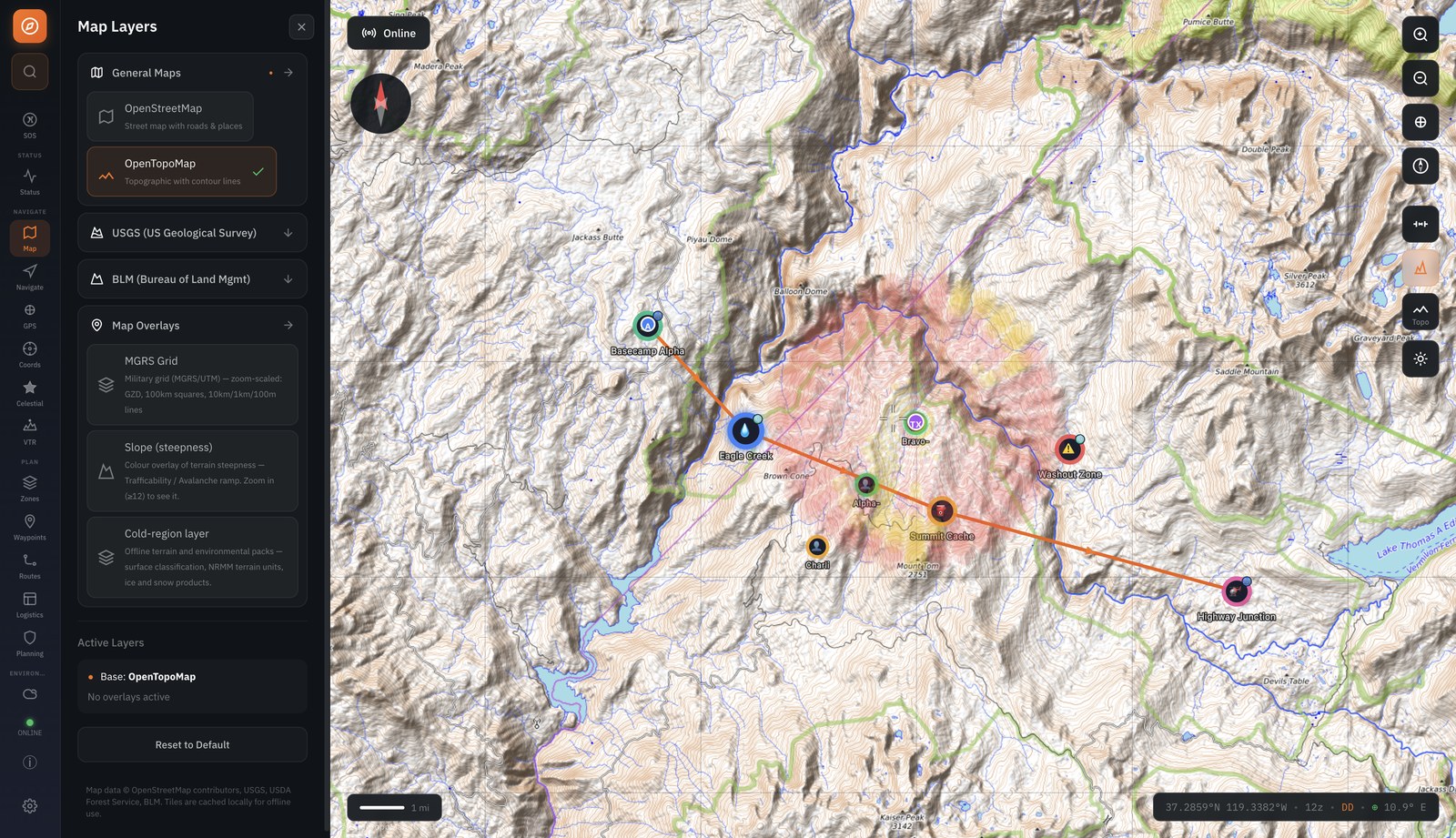
Offline Maps
Pre-cached cartography
Download and cache map tiles from OpenStreetMap, OpenTopoMap, USGS, and satellite imagery
for offline use. Import GPX tracks and KML overlays. Drop pins, create routes, and annotate
the map—all stored locally in your browser.
OSM/OTM
USGS Topo
Satellite
GPX/KML
Water Quality
Field microbiology analysis
Connect a Fluidion ALERT One analyzer via USB to test water for E. coli, Total Coliform, and
Enterococci. Results interpreted against WHO, EPA, and EU standards with treatment recommendations
and use advisories. Manual entry and file import for field teams without hardware.
Fluidion ALERT One
WHO/EPA/EU Standards
Treatment Advisories
Map Overlay
AR Overlay
Camera heads-up display
Augmented reality display overlays waypoints, landmarks, team positions, and navigation bearings
directly on your camera view. Point your device and see what's at each bearing without switching to the map.
Camera HUD
Waypoint Overlay
Bearing Display
POI Labels
Field Guides
Offline survival reference
Comprehensive offline reference database covering wilderness survival, foraging, shelter construction,
water purification, knot tying, and first aid. Available without network connectivity.
Survival Skills
Foraging ID
First Aid
Offline DB
Communication Plans
Radio frequency management
Manage radio frequencies, call signs, check-in schedules, and emergency protocols for your team.
Pre-build communication plans for operations and share them via QR code or mesh.
Freq Management
Call Signs
Check-In Schedule
QR Sharing
Exposure Tracking
Personal risk modeling
Tracks personal exposure risk based on temperature, wind chill, heat index, activity level, and
elapsed time. Models hypothermia, heat stroke, and dehydration risk with alerts before conditions become dangerous.
Hypothermia Risk
Heat Index
Wind Chill
Time Tracking
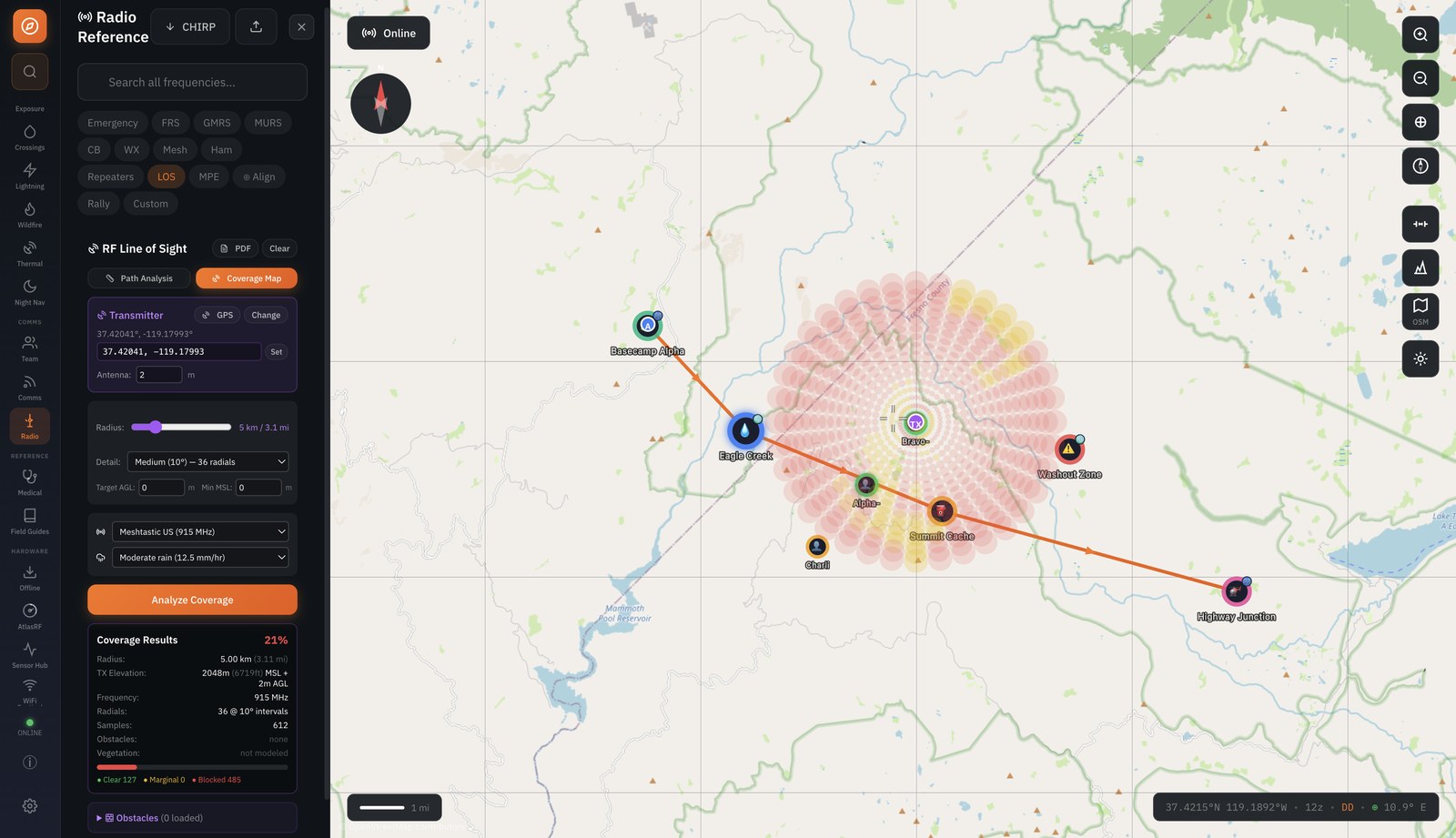
RF Line-of-Sight
Radio propagation analysis
Analyze radio propagation paths between any two points using terrain elevation data. Visualize
Fresnel zone clearance, path loss, and obstruction profiles—now factoring in man-made obstacles
imported from the FAA Digital Obstacle File (and your own placed obstacles) with multi-obstacle
diffraction modeling—for planning radio relay positions.
Fresnel Zone
Path Loss
FAA Obstacles
Relay Planning
SSTV Image Transfer
Slow-scan television over radio
Encode and decode Slow Scan Television images for transmission over amateur radio. Send photos, maps,
and situational reports via HF/VHF radio when no data network is available.
Encode
Decode
Multiple Modes
HF/VHF
External Video Feed
See what a teammate sees, over local RF — no internet
Display a live feed from a wireless video receiver — CineView, Walksnail, HDZero, or analogue
5.8 GHz — captured over HDMI by any USB UVC capture device. Selectable at 480p, 720p,
or 1080p, at 30 fps, shown picture-in-picture beside the map and off by default. The link is
local RF, so it needs no internet and no infrastructure: the picture drops when line of sight breaks
at 5–6 GHz while voice and text carry on over the LoRa mesh. Unplugging the capture device
ends the feed rather than freezing on a stale frame that would still look live.
480p / 720p / 1080p
30 fps
USB UVC Capture
Picture-in-Picture
No Internet
Cold-Region Layer Packs
Pre-built terrain and feature layers for austere northern ground
Load pre-built layer packs covering cold-region terrain and features, then render them as a gridded overlay that rotates with the map. Reprojection and tiling happen before the pack ever reaches the tablet, so a device in the field only parses, stores, and draws. Class-coded layers are drawn without smoothing on purpose — interpolating between two nominal class codes would invent a class that does not exist. Packs are stored separately from terrain-hazard data and namespaced per pack, so two packs covering the same ground cannot collide.
Offline Packs
Rotating Overlay
Class-Coded
No Interpolation
High-Latitude PNT Policy
The compass fails before the latitude looks extreme
At high latitude a magnetic compass degrades and eventually becomes useless — but the threshold is not a line of latitude, because the magnetic pole is offset from the geographic pole and drifts. GridDown keys the decision on measured horizontal field intensity instead, inflating the compass’s assumed error through a caution band and dropping it entirely in a blackout band rather than letting a confident-but-wrong heading into the fusion. Celestial witnesses are scheduled on solar altitude, including polar day. Web Mercator is also undefined at the poles, so the projection is clamped to its valid band and the view is flagged when a true polar render mode would be required.
Field-Intensity Keyed
Witness Admission
Polar Day
Projection Guard
Satellite Weather Imagery
GOES and NASA imagery, cached for offline use
Pull weather satellite imagery — true colour, infrared, water vapour, and more — in regional or full-disk views, with animation across recent frames. Imagery is cached locally so the last download stays available after the connection does not. All of it is US Government public-domain imagery requiring no API key and no account.
GOES & NASA
Multiple Products
Animation
Offline Cached
Radar Alignment Verification
Prove an external sensor is pointing where it thinks
A survey-style workflow for checking any directional sensor that reports bearing and range. Pick known landmarks, and GridDown computes true bearing and range from the sensor’s surveyed position; enter what the sensor reported for the same landmarks and it returns per-landmark discrepancies plus a multi-landmark consistency analysis that separates a constant mounting offset from scatter. Even self-aligning radars can be installed with the antenna baseline off-axis, and nothing downstream can detect it — every track is simply rotated.
Landmark Survey
Per-Point Error
Offset vs Scatter
Any Directional Sensor
Relay Hub
Turn one instance into a command-post relay
Designate a GridDown instance as a hub and it relays messages between team members who cannot hear each other directly, bridges radio traffic to and from an internet link when one exists, holds messages for recipients who are offline and delivers them on reconnect, tracks delivery confirmations, and pushes encrypted position updates to the team. Deliberately hub-and-spoke rather than mesh flooding — deterministic and debuggable, so you can say why a message did or did not arrive.
Out-of-Range Relay
Radio ↔ Internet
Store & Forward
Delivery ACKs
Mesh Topology & Peers
See the network, not just the nodes
Draw the relay network on the map as link lines coloured by signal quality, labelled with signal strength, noise margin, and hop count as you zoom in. Behind it, one de-duplicated peer list merges team members, mesh radio nodes, and Secure Messenger peers keyed by callsign, each carrying which systems it is reachable through — so a callsign shows every path to that person rather than appearing three times in three lists.
Link Quality Lines
RSSI / SNR / Hops
Unified Peers
Multi-Path Reachability
Unified Position Fixes
Every fix carries a defensible uncertainty
GridDown derives position from several independent methods — internal GPS, an external receiver, terrain resection with a rangefinder, visual terrain referencing, celestial running fixes, and pedestrian dead reckoning. All of them are normalised into one fix representation carrying real positional uncertainty, so the map can draw an error ellipse for any source rather than only for GPS. You can see how well the system actually knows where you are, and which method is telling you.
One Fix Contract
Covariance
Error Ellipse
Any Source
Logistics Planning
Route & resource analysis
Calculate fuel, water, and food requirements for any route based on distance, elevation,
vehicle type, and team size. Identifies critical resupply points and calculates turnaround limits.
Fuel Calc
Water/Food
Resupply Points
Turnaround
Night & Stealth Modes
Light discipline
Red-light night vision mode preserves dark adaptation. Ultra-dim stealth mode minimizes light signature
for operations requiring strict light discipline. Switchable with one tap.
Red Light
Stealth Mode
One-Tap Switch
NVG Compatible
Hunting
Wind-driven scent cone modeling
Real-time scent dispersion cone on the map driven by live wind data. Solunar forecasting with major/minor period predictions.
Movement scoring, stand manager with wind ranking, sighting logger with pattern analysis, thermal modeling, and terrain-aware funnel detection.
Scent Cone
Solunar Forecast
Stand Manager
Sighting Heatmap
Fishing
Solunar predictions & spot management
Shared solunar prediction engine tuned for fishing activity windows. Spot manager with species profiles,
catch logging, and conditions tracking. Pressure trend analysis for bite prediction.
Solunar Engine
Spot Manager
Catch Log
Pressure Trends
Lightning Safety
Strike risk & approach timing
Assesses lightning risk based on atmospheric conditions and storm proximity. Calculates flash-to-bang distance,
approach/retreat timing, and recommended shelter actions. Integrates with weather alerts for proactive warnings.
Flash-to-Bang
Risk Assessment
Storm Tracking
Shelter Alerts
Water Crossing
Ford/swim risk assessment
Evaluates water crossing safety based on depth, current speed, and team capability. Integrates with
USGS stream gauge data for real-time flow conditions. Risk scoring with go/no-go recommendations.
Risk Scoring
Stream Gauge
Flow Conditions
Go/No-Go
WiFi Sentinel
Passive drone detection via WiFi
Detects consumer drones by identifying characteristic WiFi probe patterns and OUIs from DJI, Skydio, Autel,
and other manufacturers. Dual-tier architecture: software scan on the tablet or dedicated ESP32 hardware sensor for continuous monitoring.
DJI Detection
Skydio Detection
ESP32 Sensor
Passive/Covert
Connectivity Monitor
Cellular, WiFi & Starlink status
Real-time monitoring of all network links via AtlasRF integration. Cellular tower details with RSRP/RSRQ/SINR and neighbor cells,
WiFi link quality, and Starlink terminal health with throughput and obstruction metrics. Automatic failover detection.
Cell Tower Info
WiFi Health
Starlink Status
Failover Detection
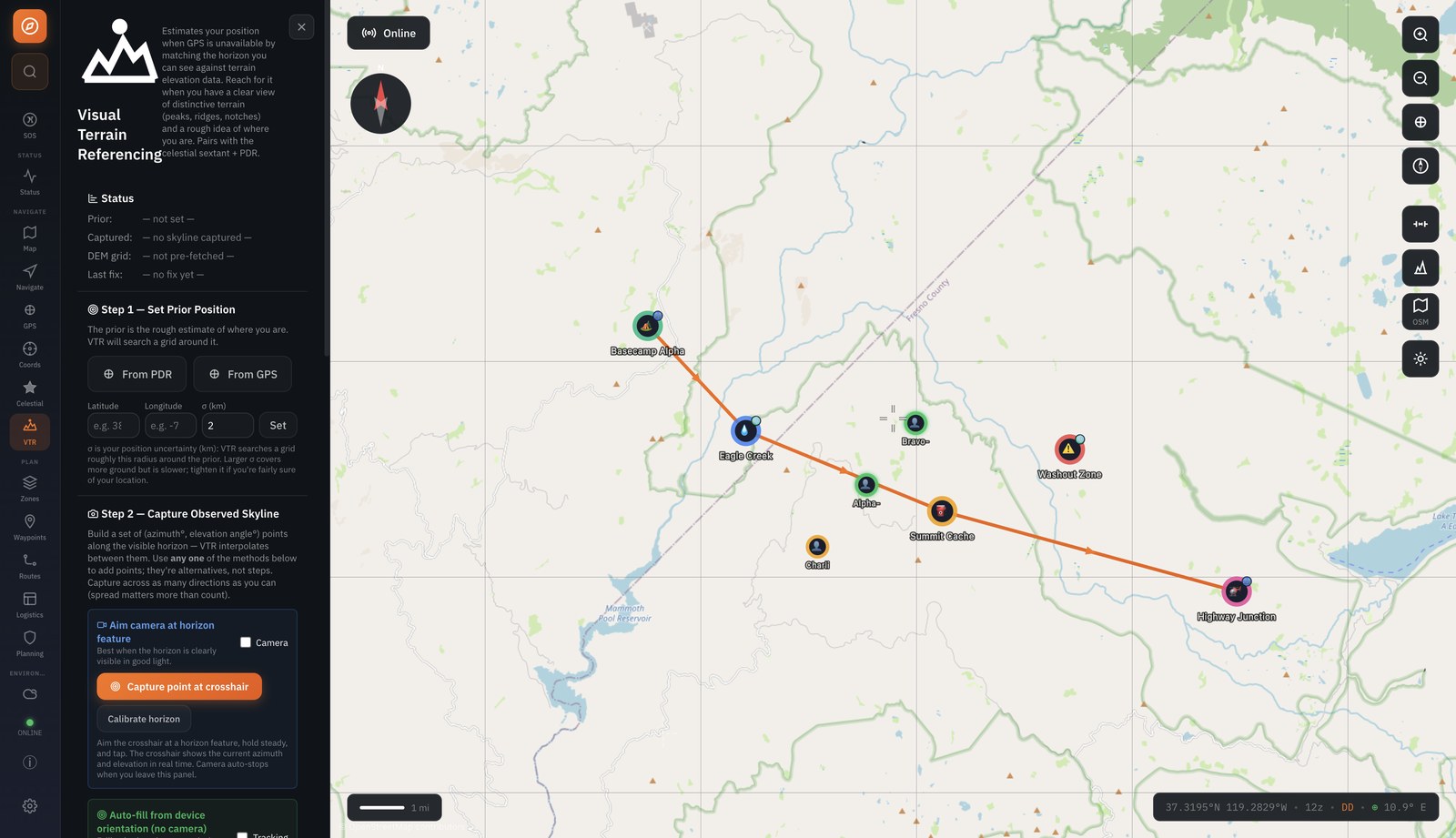
Visual Terrain Referencing
Match the skyline to fix your position
When GPS is denied, VTR estimates where you are by matching the horizon you can see against terrain
elevation data. Capture the skyline three ways—through the camera, by aiming the device
(orientation), or from a named landmark—then compute a fix around a rough prior position. Best with
a clear view of distinctive terrain. It is experimental and uncalibrated: it reports a
confidence score with deliberately conservative uncertainty and is pending field validation, so always
cross-check it against another source.
Skyline Match
Camera / Orientation
Prior + Search Radius
GPS-Denied
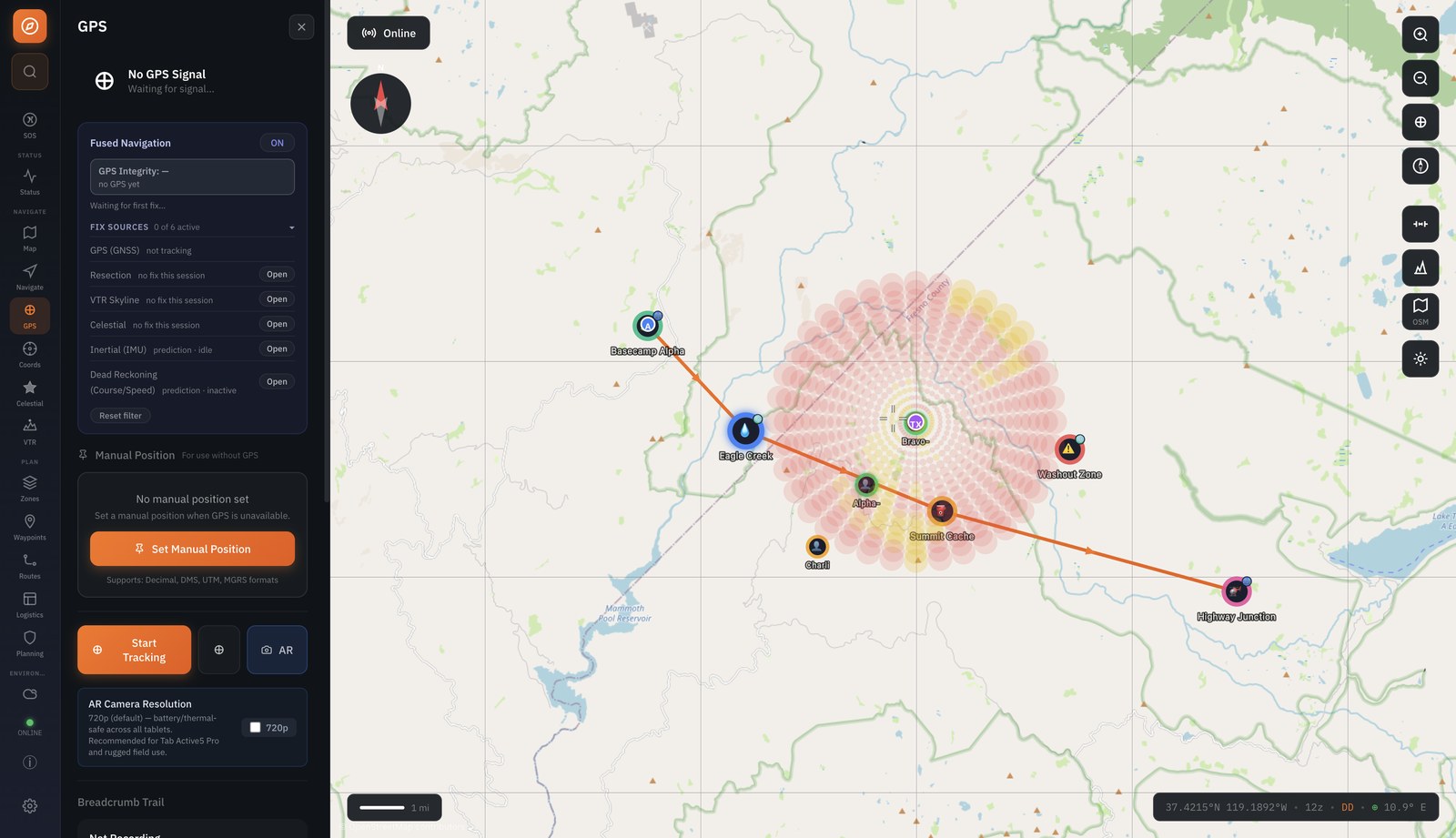
Fused Navigation
One estimate from every sensor
A Kalman filter fuses GPS, rangefinder resection, VTR skyline match, and celestial fixes—using
pedestrian dead reckoning as the motion model between them—into a single position with a 95% error
ellipse and a plain-language accuracy readout (e.g. "±42 m 95%, resection, GDOP 2.1"). Innovation gating
automatically rejects a GPS fix that jumps from spoofing, multipath, or a bad lock, and an integrity
layer warns you when GPS quality collapses or it's likely being jammed. Ingesting spoof/jam flags from
an external u-blox receiver is a planned enhancement.
Kalman Fusion
Error Ellipse
Spoof/Jump Rejection
Integrity Alerts
Wildfire & Thermal
Fire perimeters & satellite hot pixels
Overlay confirmed NIFC wildfire perimeters, unconfirmed satellite hot-pixel detections from NASA FIRMS and
NOAA GOES, and GOES infrared cloud-top and fire-band imagery. Builds a full fire-awareness picture—agency
perimeters plus near-real-time thermal signatures—for evacuation and route planning.
NIFC Perimeters
FIRMS Hot Pixels
GOES IR
Evac Planning
Rapid Access
Find any feature under stress
Unified global search (Ctrl+K) across actions, waypoints, routes, team, settings, 3,100+ named
landmarks, and offline place packs. The Situation Wizard (F1) guides you to the right tool under stress,
and a long-press "What's Here" readout aggregates coordinates, elevation, slope, sun/moon, declination,
weather, and nearby features for any point.
Global Search
Situation Wizard
"What's Here"
Offline Places
Radiation Detection
Gamma spectrometry & dose mapping
Connect a RadiaCode 101/102/103/110 gamma spectrometer over Web Bluetooth for live dose rate (μSv/h)
and count rate with color-coded threshold alerts. View the 1024-channel spectrum with peak detection and
identification of 14 common isotopes, and record GPS-tagged radiation tracks that overlay on the map. A
demo mode exercises every feature without hardware.
Dose Rate
1024-ch Spectrum
Isotope ID
Dose Mapping
Medical Reference
Offline field medicine
An offline library of 50+ treatment protocols spanning trauma, medical, environmental, and toxicology
emergencies, with step-by-step procedures and warnings. Quick-reference tables (vitals by age, CPR,
Rule of 9s, Glasgow Coma Scale) and a field-medication database round it out. A reference aid—not
a substitute for training or professional care.
50+ Protocols
Drug Database
Quick Tables
Fully Offline
Plans & Export
Paper backup & data exchange
Print or export a complete operational plan—route cards, waypoint lists, and comm plans—so
you have a paper backup when the electronics fail. Import and export GPX, KML/KMZ, and GeoJSON, and
share an entire plan as a .gdplan package between team members. Plan packages are plaintext —
send them over a link that encrypts if the contents are sensitive.
Print / PDF
GPX / KML
GeoJSON
.gdplan packages
Waypoints & Coordinates
Structured marks, every grid
Drop seven structured waypoint types—water, fuel, camp, resupply, hazard, bail-out, and
custom—with type-specific fields, photos, notes, and verification timestamps. Read and enter
positions in DD, DMS, DDM, UTM, or MGRS, and measure distance, area, and bearing directly on the map.
7 Waypoint Types
MGRS / UTM
Measure Tools
Filter & Search
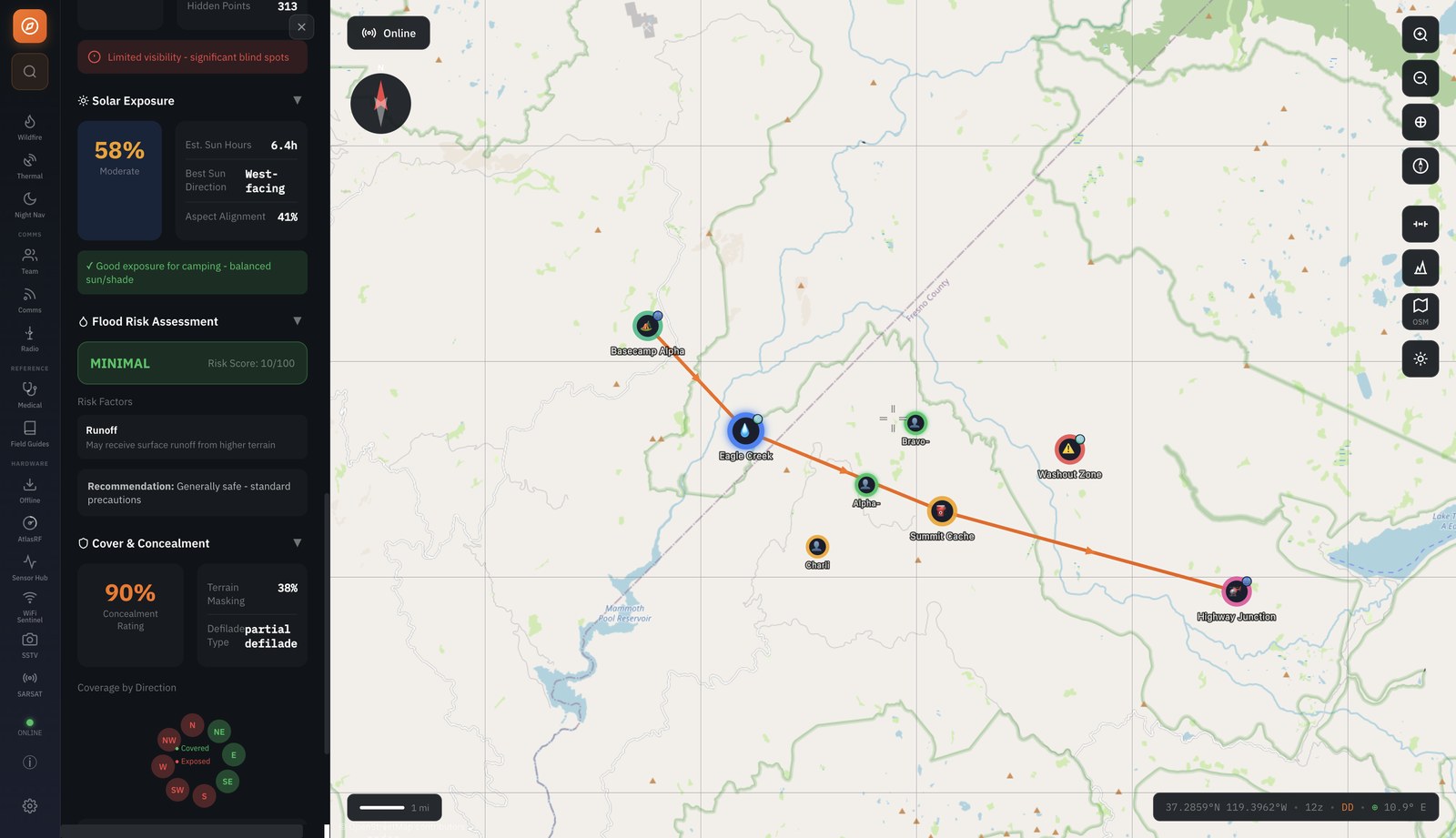
Terrain Analysis
Read the ground before you move
Compute slope and aspect with trafficability and avalanche shading, run viewshed analysis to find or
avoid observation posts, score cover and concealment, rate solar exposure for campsite selection, and
flag flood risk—all derived from elevation data and overlaid on the map.
Slope / Aspect
Viewshed
Cover & Concealment
Flood Risk
Geofence Zones
Draw the AO, get alerted
Draw operational zones and geofences on the map and get automatic entry, exit, and dwell alerts as you
or your team cross them. Zones sync across the mesh for shared awareness, import from KML/KMZ, and
cross-reference AtlasRF ground-sensor triggers—so a tripped perimeter sensor names the zone it
fired in—and display KrakenSDR direction-finding bearings.
Entry/Exit/Dwell
Team Sync
Sensor Triggers
KML Import
Status Dashboard
Whole mission at a glance
A single sit-rep screen that aggregates live status from every subsystem—GPS and fused-fix
quality, network and storage, connected radios and sensors (mesh, messenger, SARSAT, AtlasRF, Sensor
Hub), team health, and active SOS and zone alerts—so an operator or a briefer can confirm
everything is healthy without clicking through twenty panels.
Subsystem Health
Fix Quality
Radios & Sensors
One Glance
Hiking & Pace
Time, daylight & turnaround
Estimate travel time for a route from your pace and the terrain (Naismith-style, with presets from
heavy-pack to trail-runner), track remaining daylight against your plan, and get turnaround alerts so
you aren't caught out after dark.
Pace Presets
Time Estimate
Daylight Tracking
Turnaround Alert
Rangefinder Resection
Fix your position from landmarks
Fix your position without GPS by measuring distances to known landmarks with any rangefinder—laser,
optical, or estimated—and entering them manually. GridDown trilaterates your location from the
bundled 3,100+ landmark database and feeds the result, with its uncertainty, into the fused estimate.
Trilateration
Any Rangefinder
Landmark DB
GPS-Denied