01 — Ingest
Standardized Input
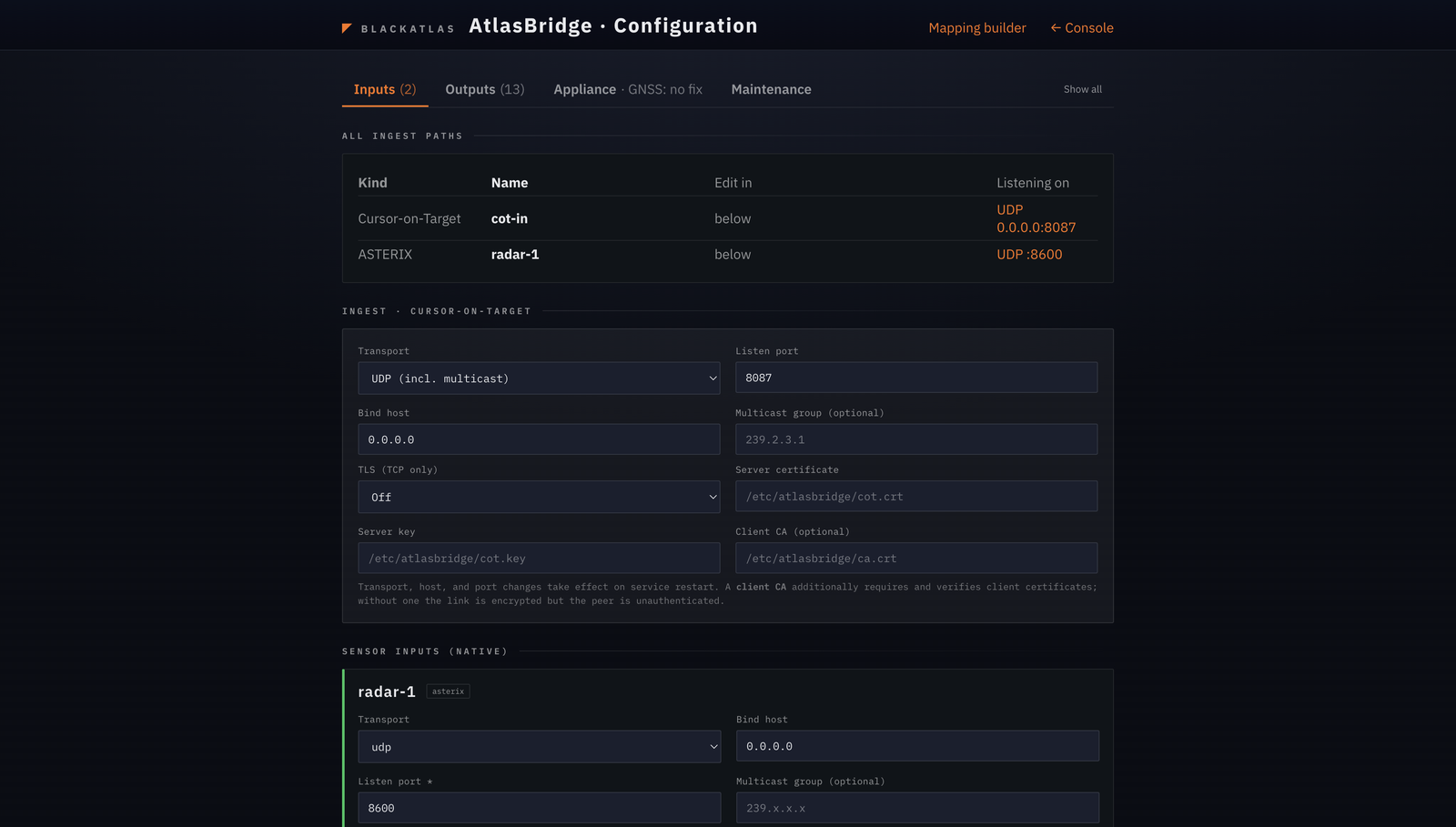
Connect your sensors over the transports they already support. AtlasBridge accepts structured detections without bespoke per-sensor engineering.
02 — Normalize
Canonical Model
Every detection maps to one internal schema that preserves full fidelity — position, classification, confidence, RF metadata, and track lifecycle.
03 — Publish
Simultaneous Output
Stateless translators publish the same stream to multiple C2 systems concurrently, each with correct entity lifecycle and stale-track handling.
04 — Survive
Disconnected Operation
Built for DIL networks. When a link drops, a persistent store-and-forward queue buffers detections on-device and delivers them in order on reconnect — nothing is silently lost.
05 — Control
Per-Output Filtering
Decide exactly what reaches each destination. Filter by classification, confidence, geofence, disposition, or sensor — different rules per C2 system, all from one picture.
06 — Translate
Coordinate & Time Aware
WGS84, MGRS, and UTM conversion at the boundaries, with time-source monitoring so entity lifecycle stays accurate even in degraded-PNT conditions.
07 — Translate
Altitude Datum Correction
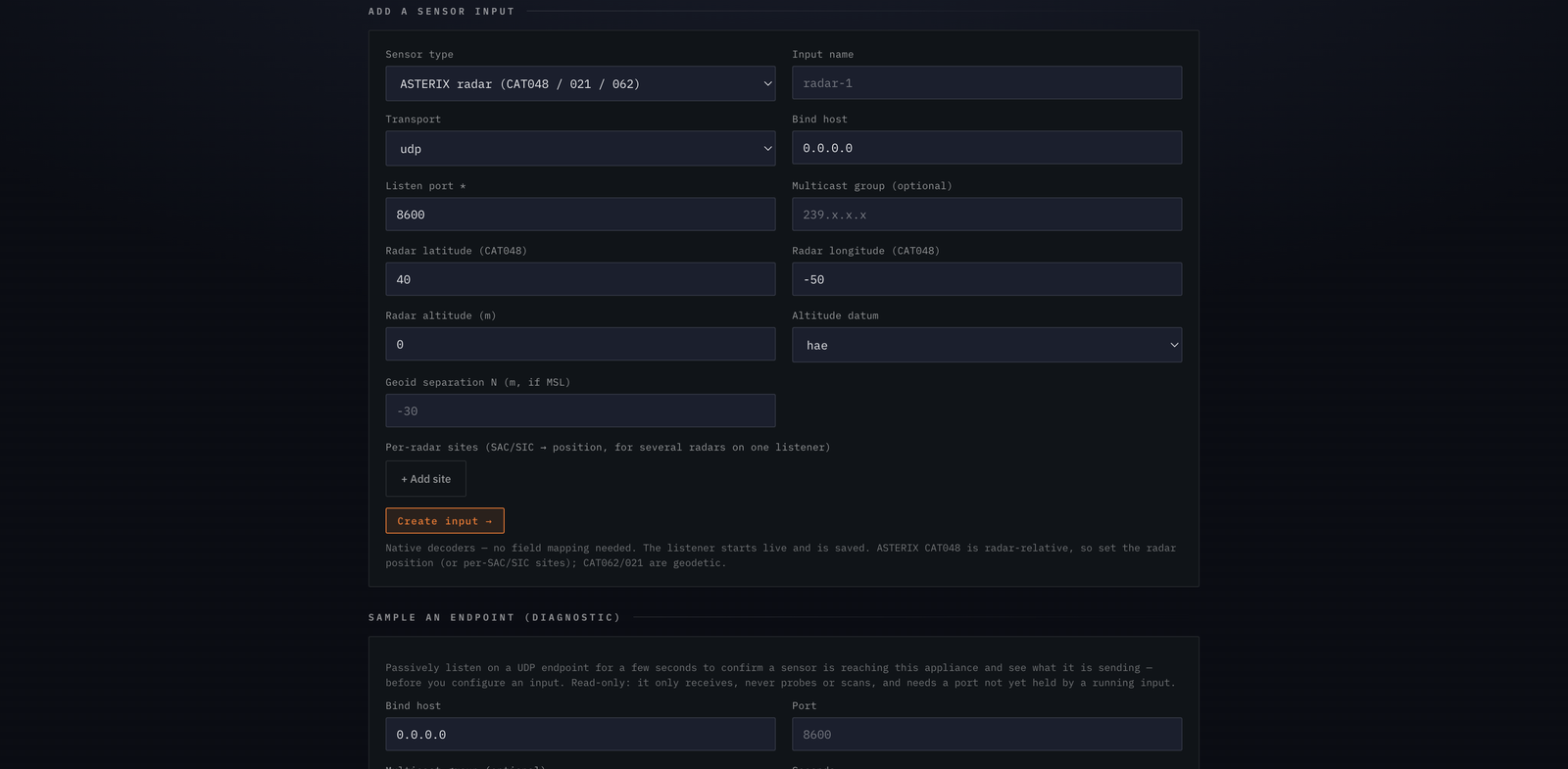
Sensors disagree about what “altitude” means. ASTERIX CAT048 reports height above mean sea level; the canonical model carries height above the WGS-84 ellipsoid. AtlasBridge reconciles them per input, and an optional GNSS receiver supplies the local geoid separation directly from its position fix rather than from a table. In the continental US that correction runs to tens of metres — the difference between a track at the right altitude and one that looks airborne when it is on the ground. A declared-MSL input with no separation available is passed through unchanged rather than shifted by a guessed offset.
08 — Diagnose
Sensor Inputs Panel
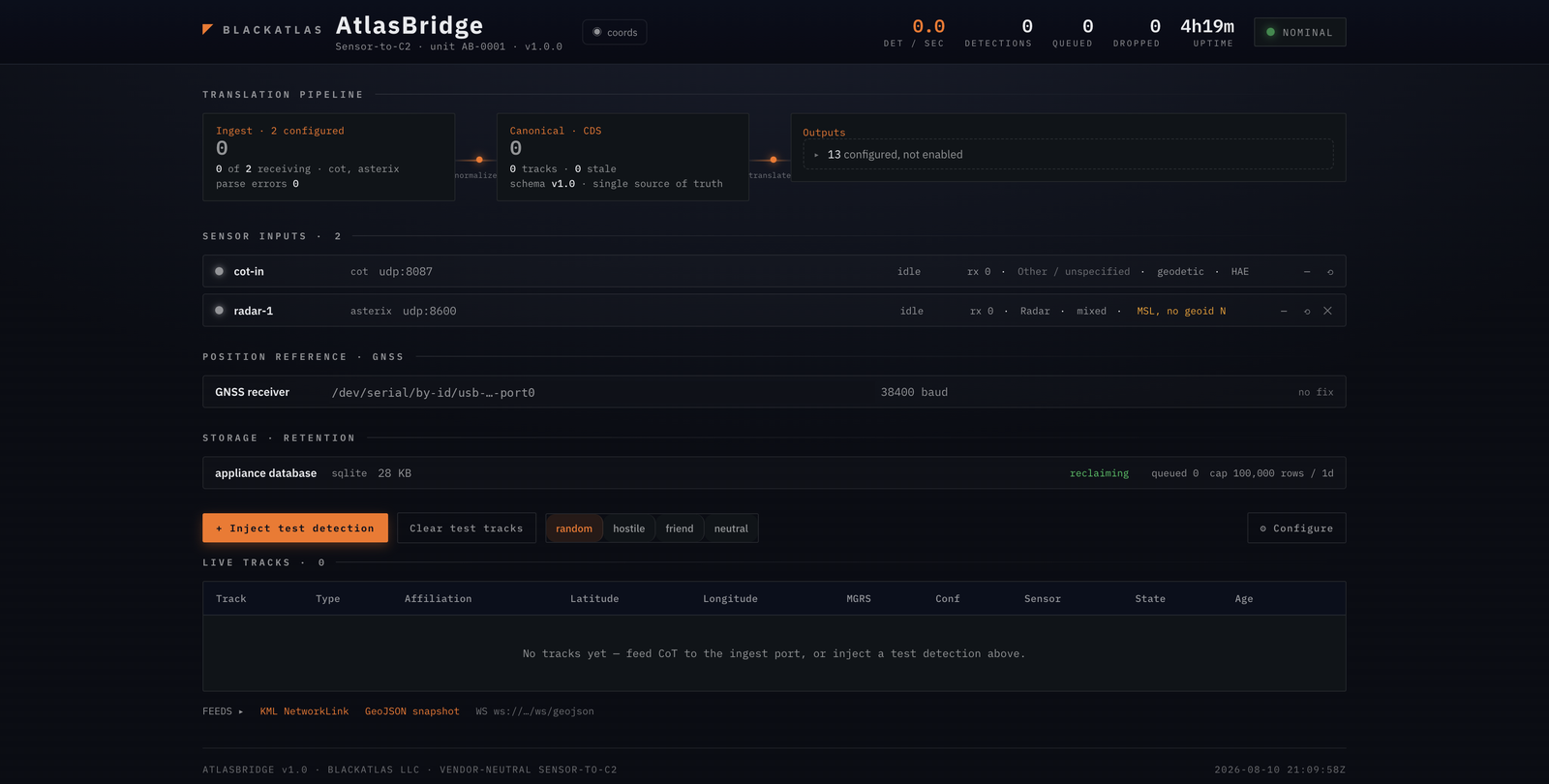
The first question on any field call is whether the sensor is broken or the bridge is. The console answers both halves side by side: what AtlasBridge observed — frames received, errors, kernel-level drops, per-input connection state — and what each sensor reports about itself. SAPIENT status reports and ASTERIX CAT034 service messages are normalised into one health model, so a sensor reporting its own degradation shows as degraded rather than merely quiet.
09 — Diagnose
Switch Health Panel
Optional, and it closes the last gap in the same question. AtlasBridge polls a managed switch over SNMPv2c for per-port link and power-over-Ethernet state using standard MIBs, then maps switch ports to inputs — so the console shows whether a given sensor's port is up and powered. That separates “the sensor died” from “the switch stopped powering it,” which per-input connection state alone cannot tell you. A port fault pages through your configured alert outputs. Read-only, vendor-neutral, off unless configured, and intended for an isolated management VLAN.
10 — Diagnose
Passive Endpoint Probe
Point it at a port or multicast group and it listens for a few seconds, reports what arrived, and identifies the protocol using the same decoders the ingest path uses. Strictly passive — it binds and receives, never sends, never scans a range, and needs no elevated privileges. It answers “is anything actually arriving, and what is it?” before you start editing configuration.
11 — Integrate
Mapping Without Code
Describe how to pull fields out of a proprietary feed — JSON, XML, delimited, or regex — and AtlasBridge emits canonical detections from it. The mapping is data, not code: field paths plus a fixed transform registry, with no expression language and no evaluation, so a customer-supplied mapping cannot execute anything. XML is parsed with entity and DTD rejection and a size cap. Hand it a captured sample and it drafts a conservative starting mapping for you, validating candidate values rather than trusting field names.
12 — Integrate
Mapping Builder & Live Track Table
The console is where integration actually happens. The Mapping Builder walks you through pointing at a proprietary feed and picking out its fields, opening on a draft mapping inferred from a captured sample rather than a blank form. Beside it, a live track table shows what is currently in the picture — so you can confirm a new sensor is landing correctly before you point a single C2 destination at it.
13 — Interoperate
BDX — A Published Detection Schema
BlackAtlas Detection eXchange is not another wire protocol. It is the published, versioned interchange schema for a normalised detection across AtlasRF, the Sensor Hub, GridDown, and AtlasBridge itself — with AtlasBridge’s canonical model as the reference implementation. One detection shape across the whole ecosystem, and one Cursor-on-Target type mapping rather than a copy per product.
14 — Prove
Conformance Harnesses
Interoperability claims are testable, and AtlasBridge ships the instruments to test them. A SAPIENT harness drives the real output node — registration, status heartbeats, detection reports — through a capture server and validates it against an external BSI Flex 335 v2 conformance validator. An ingest harness runs the mirror image, generating known-good SAPIENT and ASTERIX traffic and confirming AtlasBridge parses and translates it correctly. A ship-gate harness closes the pre-delivery interop checks on real hardware, each gate with a stated objective and explicit pass criteria.
15 — Operate
Burst Tolerance You Can See
A radar dumping a swarm update can outrun a default socket buffer, and those losses happen in the kernel before any application sees them. AtlasBridge enlarges its ingest buffers and reports kernel-level drops explicitly, so packet loss shows up as a number instead of as tracks that quietly never appeared.